Wednesday, 30 April 2014

Madre - Naples

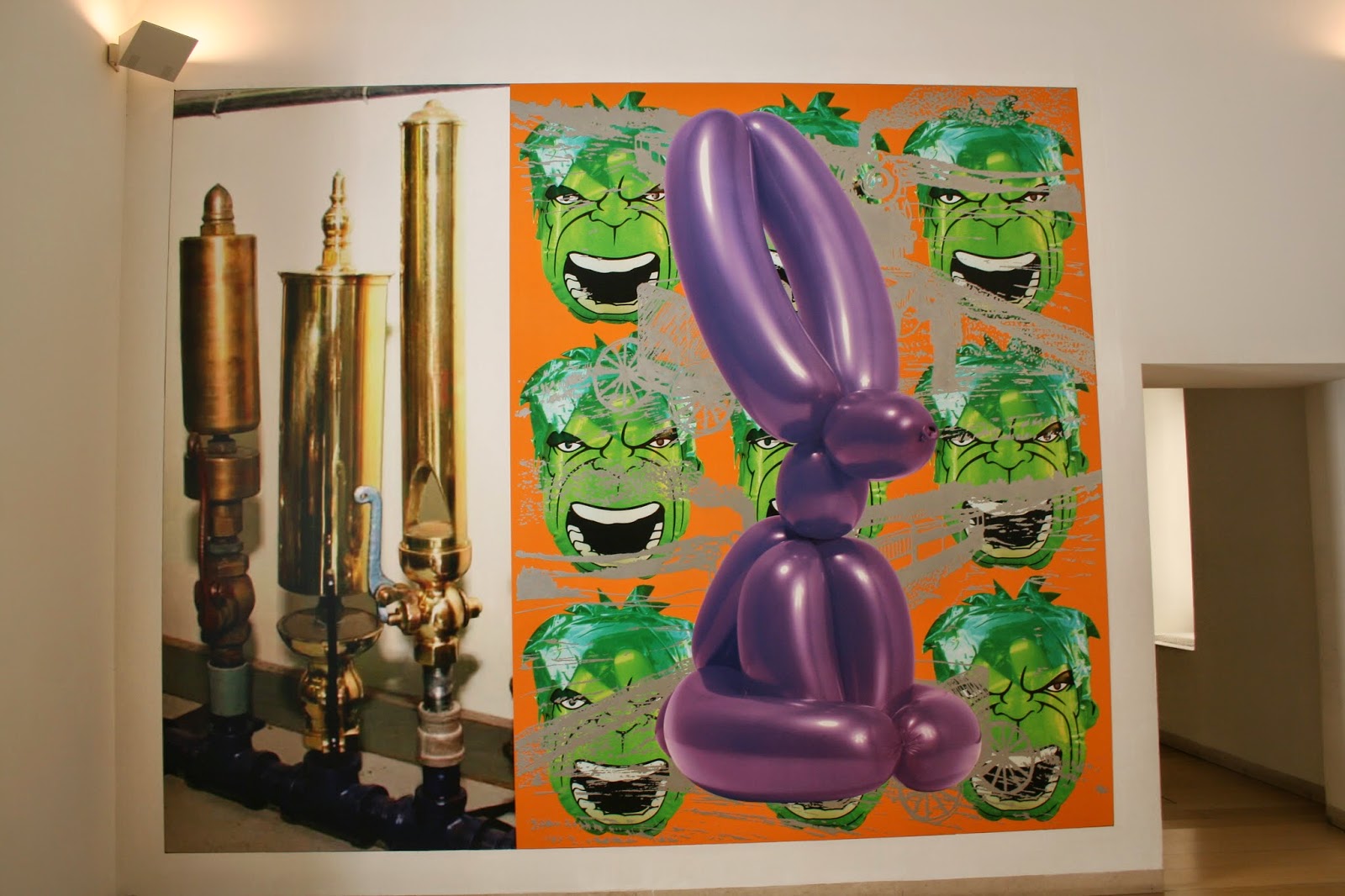
Naples has a wonderful collection of modern art at the Madre.


Who knew that the treasures it contains would include Richard Long, Anish Kapoor, Sol DeWit and Jeff Koons amongst its site specific works?

All housed in an incredibly beautiful palazzo, hidden down a pretty dodgy looking street, where, and of course, this is Naples, the washing is out to dry all over the place.

Four huge floors of wonderfulness, where it is just too tempting not to join in.

Don't miss it in favour of the truly awful Capodimonte Museum, which is not worth the bus ride up the hill, especially on a rainy day on account of the closed galleries  - typically all the contemporary collection was off limits - and the worst pizza in the city.

Sunday, 13 April 2014

Amsterdam Writers Guild

It was a pleasure last Sunday to read for the newest guild of writers in Amsterdam as guest poet before their annual slam competition. They are an impressive group, all writing poetry expertly in their second language.  Check out their events next time you are in town.

I am especially glad that I sold so many books. That's just what the unloved poet most wants: people to listen, but then actually buy my words. Thank you all, and for the opportunity to actually read from behind a circular bar - a first.

The Rijks Museum all new and shiny

Like most hundred year or more old institutions in Europe, there comes a time when it has to shut it's doors, take a long hard look at itself and embark on the process of reinvention for the 21st century. Thus the Rijks Museum in Amsterdam was out of bounds for a few years while it morphed into a museum able to cope with the hoards to visitors who come to soak up the Golden Age of Dutch painting and collecting. It reopened a year ago with shiny new marble entrance way, cafe and lots of glass.

I missed it on my last trip to the Dutch capital by a few weeks, so I have and to wait patently for the next opportunity to reacquaint myself with the wonderful Rembrandts,  three Vermeers and the handful of Van Goghs in the collection.

It was an absolute treat last weekend, only midly interfered with by royalty. I wondered why there were so many people hanging around in the Rembrandt gallery, but shrugged it off and carried on looking a a painting when a tall perfectly dressed security guard asked me if I wouldn't mind standing to one side.
    'Why?' I asked him in return.
     'Because I am asking you nicely,' he said.
     'No, why are you asking me.'
     'Because the King and Queen are coming with the Queen of Sweden.'
     'They're only people,' I said indigently and reluctantly moving away.
I felt like adding, And I bet they haven't paid their 15 euros each to get in. As you tell I am not a fan of any kind of privilege. It rather put me off the rest of my visit, but don't let that stop you, the royal family don't live in the Rijks Museum.

Wednesday, 5 March 2014

Henri Cartier-Bresson at the Pompidou

What do you deduce if, as a member of the Pompidou, you still have to wait in line to see the latest big show? Well, that the French like photography, naturellement, and that this a show worth seeing, bien sur.

Henri Cartier-Bresson went everywhere and photographed everything in the twentieth century from the Spanish civil war - he was in the International Brigade, to the second world war - he was in the Communist Resistance, to Ghandi's funeral, to the 1968 uprising.

This exhibition is huge and showcases his entire oevre from experiments in Surrealism, to portraits of the great and the good - there's a wonderful one of Matisse and his pigeons.

There is so much to see and enjoy. Marvel at the technique and his brilliant composition. Watching footage of him photographing in the streets of Paris was an education in the speed at which he worked.  Some of my favourites were the homages to well known Impressionist paintings.

Two hours disappeared in a flash, if you'll pardon the pun. It's an tour de force. If a picture speaks a thousand words, then 500 say, well, you do the maths. Seriously, don't miss it. It's on until June. I will be back next time I have a visitor. Wait, that's this weekend.

Saturday, 1 March 2014

Dylan Thomas for St. David’s Day


Actually, this poem has nothing whatsoever to do with St. David’s Day other than the fact that I am writing about it today. So whilst the nation is busy sporting daffodils, anthem singing, dressing up in national costume of dodgy provenance and being rightly proud of itself (Wales 27, France 6, just to remind you), I am sitting in rainy Paris, reading.

The force that through the green fuse (pg. 13) deals with the big issues life, love and death which haunt most of Dylan’s poetry. The force, and yes, you can think Star Wars here if it helps, seems to be the notion of universal energy. It is both life giving and life taking as the poem is packed with these opposites from the natural and human world, every stanza has this.

The poem starts with a repetition of the title in the opening line. It’s striking these days how archaic this structure seems to be. It’s unnecessarily repetitive and something most current poets try to avoid. That said, what of this mysterious ‘green fuse’? Young spark I think we might say more clunkily, but it’s arresting and functions to call the readers’ attention from the start – you are going to have to read this one carefully.

As well as the pattern of opposites, the poem focuses on the poet being silenced – the word ‘dumb’ is used in each stanza, but, of course, this is an irony as the poem is anything but silent on its topic. Perhaps it is better to think of this less as silence and more as an inability to articulate fully.

Key words, because they are repeated, are water, blood, love, hang, force, crooked and wind; the basic elements of life and death, if you will. This writing is again in contrast to contemporary practice where we tend to eschew non-patterned word repetition, but we are forgiving readers and can luxuriate otherwise in the imagery.

The antecedent poem that this brings to mind, and which Dylan acknowledged, is Blake’s Sick Rose, with its invisible worm, both of which Dylan makes crooked here:

O rose, thou art sick:
The invisible worm
That flies in the night
In the howling storm

Has found out thy bed
Of crimson joy.
And his dark secret love
Does thy life destroy.

I once went to a lecture by Germane Greer, who talked for over an hour about these eight lines of Blake’s, so Good Luck trying to explain that in one short blog post. Dydd Gwyl Dewi hapus.


Sunday, 23 February 2014

Poetry News - Launch of I-spy and Shanty

Super exciting week coming up.

I am launching my new book at Culture Rapide on Thursday 27 February at 20h.

All details here.

Friday, 7 February 2014

Dylan Thomas On Welsh Poets and Artists

I am using my 1983 Everyman edition of Quite early One Morning (pg. 139-154), the compilation of radio scripts, for this post. There are two essays: Welsh Poets, and Wales and the Artist. In the first Dylan looks quickly at Henry Vaughan, Edward Thomas, W. H. Davies, Idris Davies, Glyn Jones and Alun Lewis, a poem or two from each and makes some pithy comments. He introduces these half dozen meritorious Welsh poets (all men) by distancing himself from his contemporaries, busy beating themselves up about not writing in Welsh; 'It is the poetry, written in the language that is most natural to the poet that counts, not his continent, country, island, race, class or political persuasion.'

He skips from Vaughan (17th century) straight into the century with Edward Thomas, killed in 1917, the great lover of the countryside. The poem Dylan chooses echoes with a death knell ('the bell on the buoy in the bay') and the tender reflection Dylan ascribes to his work. There is a classic Dylan list here worthy of reading.

Dylan describes W. H. Davies (the Super Tramp, you may know him as) as a unique observer of the 'tiniest reflections on the natural world.' He offers The Inquest and The Bust, like all the other poem choices without further comment. It is up to the reader to form her own view.

Idris Davies work is a contrast to the truth and beauty of the rural idyll. Dylan describes how he and others in South Wales wrote of 'the lies and ugliness of the unnatural system of society under which they worked,' or in the Depression 'under which they were not allowed to work,' in 'ragged and angry rhythms' with Davies shaping this violence into real poems.

Cue Dylan list number two. These two rhetorical devices make for an interesting contrast one with the other and sum up theWales of Dylan's lifetime. It is ironic that so little has changed in the ensuing seventy or eighty years.

Glyn Davies' experiments using Welsh Bardic forms in English only succeed for Dylan in 'warping, crabbing and obscuring the natural genius of the English language,' so he choses a sub-Lawrencian poem that avoids  awkward sound and syntax.

Finally Dylan presents Alun Lewis, describing him as 'humble before his own confessions, awed before the eternal confession of love' and for whom 'in war, the poetry is the pity.' Lewis was killed in an accident in India in 1944.

By contrast to the praise heaped on the poets of Wales, Dylan unleashes his vitriol on its artists in the next essay. In a wonderful piece of (surely) self-deprecation, he bemoans the Welsh in London, who try to lose their accents and end up sounding like their mouths contain the Elgin marbles, and who set up in exile a 'government of dispossessed intellectuals, dispossessed not only of their country, but their intellects.' Ouch!

On the other hand, and to be fair, Dylan rounds on the stay at home Welsh artists too, too many of whom 'spend too much time talking about the position of artists in Wales.' This short piece ends with a much quoted aphorism: 'There is only one position for an artist anywhere, and that is upright.' Is there a tongue in his cheek here? I think so.