Showing posts with label architecture. Show all posts

Wednesday, 25 November 2015

Gothic London


Image not from the Museum
In the thrub of the city, there are quiet, small spaces of calm if you know where to find them. Take Lincoln’s Inn Fields on a Saturday morning when the law is at rest, for example, or the imaginary monk’s cell and parlour in the basement of the Sir John Soane Museum that abuts the park.

It is wasteful, almost profligate to spend the hours of sunshine on a winter’s day indoors in the semi-dark amongst gargoyles, a marble skull, heavy furniture and blood red walls. But with my teenage Goth daughter in tow and delighted by everything here from the architectural ‘specimens’ to the fabulous sculpture packed into every square inch of the house, there was no choice. And more, it was a positive choice to keep from the Arctic cold that arrived with insufficient notice for me to pack properly last weekend.


As usual, I wanted the fires lit, everyone else banished and the place to myself, a good tome from the library and a pot of tea. My needs are fairly simple, no? Barring that, free entry, an exhibition on death and architecture and four of Hogarth’s paintings from the Rake’s Progress kept us more than happy for the morning.

Tuesday, 1 September 2015

The Grayson Perry House, Wrabness

Wrabness is a small nowhere kind of a place on the incredibly beautiful Stour estuary in Essex, blighted only by views of Feilxstowe, but docks and container ports have to go somewhere now,  don't they? There is a railway station, a pub or two, a community shop and the Grayson Perry House.

Nothing to see inside unless you book it at vast expense from the Landmark Trust, but it's free to walk around the garden fence and take a few photographs of this amazing confection for Perry's fictional all-Essex woman, Julie. Go on a sunny day when the roof is positively golden and it is something of a marvel.

Saturday, 7 March 2015

Architectural Sauvage/Salvage


During the French Revolution the statues of the kings of France were toppled from the facade of Notre Dame by a mob intent on destroying not religious idols, but the idolatry of Feudalism. They were decapitated, blinded, gouged and left in a heap to be used a a public toilet. They were cleared away at some point and used to shore up the foundations of a building. They were discovered by chance in 1977, the year that was the zenith of punk with its, here, ironic cry of "Destroy."

Knight killing a King, Mediaeval stained glass, Musee de Cluny
Today they are displayed in the day-lit salle de Notre Dame in the Musee de Cluny, but not in silence as the air conditioning keeps up enough noise to drown out passing police sirens from the street outside. A few people wander in and out, not staying long enough to do more than give a sideways glance to the worn crowns (in both senses), broken noses and crumbling stone. The noise seems right. Calm would be too much reverence for these relics of violence.

Art is destroyed in all revolutions, it seems to be part of the process, clearing away the old, making room for the new.  There are many examples - in my own lifetime, say those statues of Lenin littering architectural salvage yards in Britain in the 1990s, the Banyam buddahs blown skywards, the libraries in Timbuktu, and this week the destruction of Nimrud by bulldozer. We may not like it. We may call it a war crime. We may not even think it qualifies as art in some cases; cultural heritage comes in many guises.

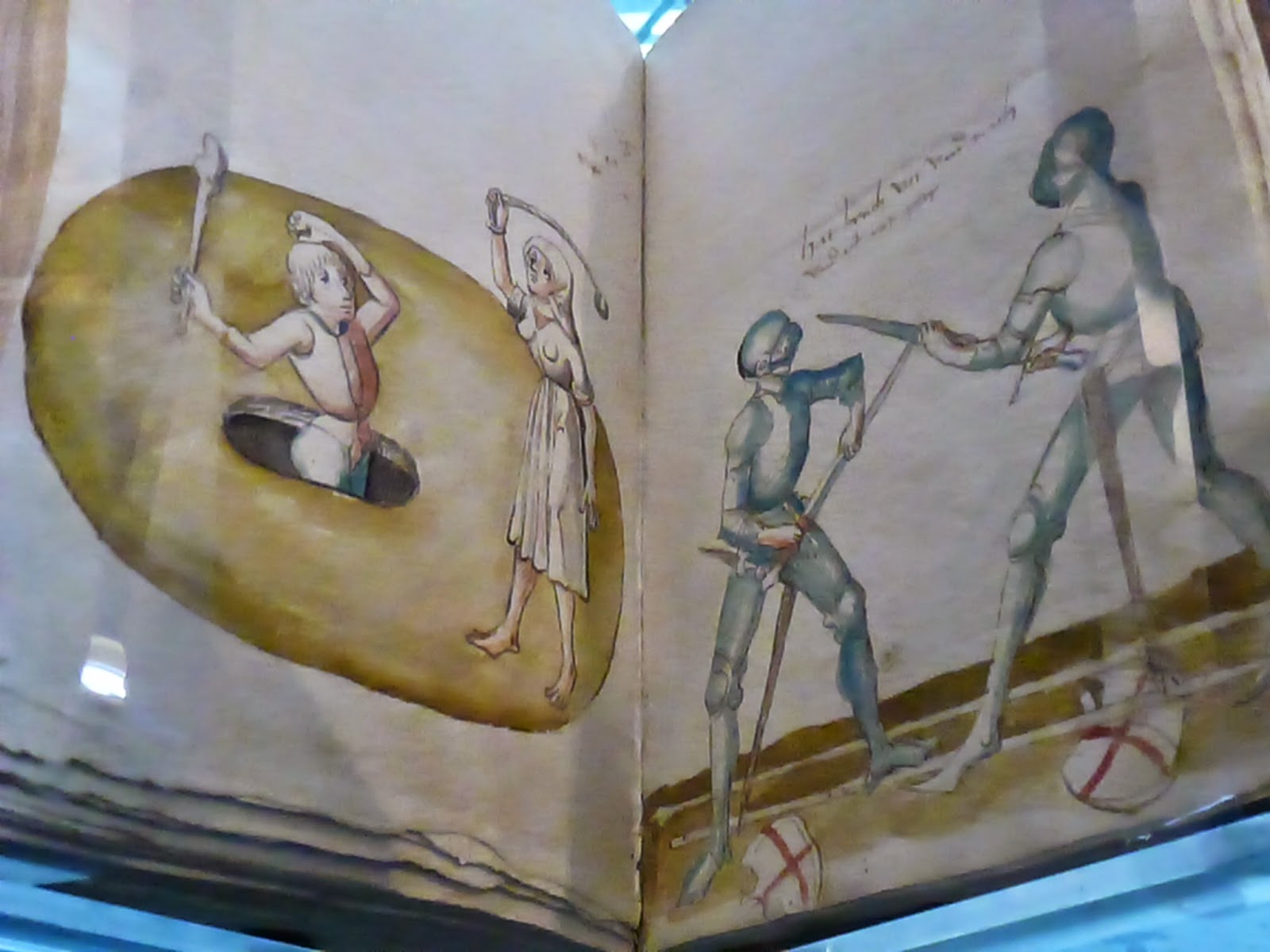
Mediaeval book on the art of warfare, Musee de Cluny
The pity of it is that no human shield saved that part of the Assyrian Empire, unlike the Cairo Museum. People are rightly too terrified of the men with guns. And we? We watch from afar, safe in our places. We sit and we watch our screens and tut and say it's terrible and do nothing, except write, as I am free to do now. The irony of this post is not lost on me.

Idolatry, Mediaeval stained glass, Musee de Cluny
But what of the hypocrisy of selling artefacts to fund oppression, whilst obliterating others for fear of idol worship. How exactly do you chose, I wonder? I imagine portability is the key. Large statues don't exactly fit in the post. And what's the point of having all those automatic weapons and jack hammers if you are not going to use them, pray? But who is buying the looted treasure, and why don't we hear so much more about and do something about the daily destruction of human lives? Could it be because any kind of action really is in the too-difficult-no-quick-buck-in-it box? If it is, then I despair, again.

I was taken recently by comments in a interview with Mark Rylance in which he pointed out that Islam was about 500 years younger than Christianity and 500 years ago we were busy chopping off heads, burning people and smashing idols. It was called the Reformation (and Counter-Reformation). So is what is happening today very much of a surprise? No, not really, but at least the Assyrian culture lives on in other museums. Reason then for not giving back acquired things? Perhaps.


Sunday, 16 November 2014

Foundation Louis Vuitton

You know, the new Gehry building...to which I am often greeted by blank stares, but really what did you think all of those builders have actually been doing in the Blois de Boulogne for the last two years?

OK. OK. So not everyone works in Mordor and has a good view of the park from their office window and not everyone has watched Gehry's latest masterpiece rise up above the treetops.  Even so, time to get with the programme Paris.

It is the most amazing building, a ship, a vessel in glass, wood and steel, surrounded by a modern moat and waterfall and with some stunning site specific artworks and some of highly dubious taste and art content and a lot of empty space for more, I guess when they get around to it.

But back to the building, it's wonderful, really.

Do go and inspect it for yourself, you will find it all ship shape and Bristol fashion and if you want to know more there are three exhibits: one with all the maquettes, plans, doodles etc another a specially commissioned film, but the most intriguing was the exhibition without artworks explaining all the stories, graff and scribbles which the builders added to the walls in the building process and which are, of course, all now painted over. These are a fascinating account of contemporary experience, history and culture and well worth your time.

Olafur Eliasson
As for the art work, well, Olafur Eliasson (you know, he of the sun in the Tate turbine hall a decade ago) has made a calming and warming light installation in the grotto and Gerhard Richter has filled an enormous room with some very fabulous paintings and some less so.

Ellsworth Kelly has covered the auditorium and other spaces with his coloured panels, but not exactly being a fan of these I'm not falling for the whole chromatic harmony palette BS.

Gerhard Richter
Cerith Wyn Evans' flute installation is truly magical, but as for the rest, it is not worth writing home about (especially not the hideous rose in the foyer.)

Nothing that innovative, nothing worth queuing to see.

Some things actually need dismantling and putting into storage, preferably the kind of warehouse where they don't have a sprinkler system and employ careless chain smoking security guards.

I hope the Foundation acquires a great deal more work to make the 14 euro entrance fee really worth it. They also need to double the cafe space and seriously reconsider the price of the books, which is frankly, exorbitant.

Top tip, unless you want to look pretty stupid, there is no need to bring your matching handbag.

But back to the building, it's fabulous, really.


(There goes my poet in residence commission, but, bothered?)