Showing posts with label art museums. Show all posts

Saturday, 15 August 2020

Returning to the gallery


Like every other art lover, I've been starved of the objects of my affection for five long months. I choose that verb with care; art is literally that nuturing to me, and looking a pictures and exhibition tours and even taking myself around Casa Azul interactively is absolutely no substitute for the real thing. My joy was unbounded when the galleries reopened. Yes, one has to be organised and book in advance, even as a member, but this is simple enough.

First off I went to White Cube in Bermondsey for Cerith Wyn Evans' glass sculptures. I've always loved his flutes and, as well as one of these, there are cracked windscreens and some lovely calligraphy influenced by the Japanese paintings. Free and empty of no more than half a dozen people when I went, it was one big of sigh of relief to be back.

Next the Tate opened, so I've now had time to see the Beardsley, which was only on display for a nano-second before the lock down. Again, one of the great benefits of limited numbers is that there is no straining to see the art works. Take as long as you like and people are pretty courteous at sharing the space. I spent a happy morning penis-spotting. Gone on, admit it, so will everyone who comes to this show, taking particular pleasure in the ones that missed the censoring eye of his publishers. The Salome prints are familiar, but there are a great number of other things to explore and enjoy.

And to round things off for the first fortnight, Warhol at Tate Modern, was a surprise. Just when you think you have seen every possible thing about and by Warhol, there were works that were new to me, and at least one (Marilyn's lips) that has never been exhibited in the UK before. Careful crowd control made this a very worthwhile trip. Hurrah and bravo. It is so good to be in one of my favourite places, and for it to be empty, as, if truth be told in recent years, I have found Tate Modern to be a bit of a scrum.

Wednesday, 8 March 2017

Hidden Paris - Musee Bourdelle

If you are sloping around Montparnasse looking for a peaceful spot, go no further. This small museum, built around Bourdelle's atelier and adjoining buildings, has beautiful courtyard gardens packed with his sculptures, as well as large exhibition halls with the same, including plaster casts.

Bourdelle was a student of Rodin and there are some influences to be spotted, but mostly his work is massive, muscular, even the women, and substantial. If you like your bronzes this bold, you will enjoy this hugely.

It was encouraging to see students sketching on a sunny day. Oh, and it's free to visit, plus you may be greeted by the smiliest  and most welcoming museum staff in Paris.

Monday, 4 April 2016

Delacroix and the Rise of Modern Art, National Gallery

The National gallery does hang pictures well. Another stunning exhibition in which the canvasses sing from the well-illuminated walls.

A must see for the spring in London if you want to observe his direct influence on the next generation: Cezanne, Reniour, Van Gogh, Gauguin, Odillon Redon and the like, and if you want to see surprising paintings by artists you think you know: a pieta by Van Gogh, huge nude from Cezanne and so on.

Strange that I go to an exhibition of French painting in London, but hey, whatever.

Saturday, 27 February 2016

Anslem Kiefer at the Pompidou


Kiefer’s work is always monumental. That’s why one piece of stacked shipping containers, filled with unfurling rolls of photographically imprinted lead, takes up more than a floor’s height in the atrium of the Pompidou. It’s why this show of 150 works goes on for room after room, some containing as few as three canvases, such is the scale.

Wear sensible shoes and don’t expect to be able to sit down very often. This is a marathon, but a very worthwhile one. It’s a huge and impressive survey of his work and certainly bears more than one visit to take it all in. I particularly enjoyed the vast landscapes and architectural paintings, and the installations behind glass.

The early rooms deal with the German past, including the Nazi uniform paintings which first brought him to attention. Later a recurring motif is the snake, which slithers its way from painting to sculpture and back again.


Much here is narrative, including books incorporated in paintings and painted books, and it is fertile ground for letting your imagination run riot. Make up your own stories, while admiring the muscularity of the paint work, even flowers have a thickness and strength that command one’s attention.

Wednesday, 3 February 2016

Frank Auerbach at Tate Britain

Frank Auerbach is an acquired taste: one that I have yet to sup willingly. I am not exactly fond of his thick layers of paint and the dull palette mixes of sludge and mud. And judging by how quiet this show was on a Saturday afternoon, I am not the only one.

If find the early to mid career work depressing, but he later work is vibrant, and even cheerful, now that he has dispensed with layering and is scraping off paint before reworking.

His London landscapes in different seasons are lovely. The most impressive for me were the charcoal portraits and self-portraits - very resonant.

Go, if he's your cup of expressionism, otherwise he's unlikely to grow on you by means of this show alone.

Saturday, 9 January 2016

Hidden Paris - Musee Zadkine


Making good on my promise to visit Paris' less well known museums this year, I started with the Musee Zadkine, housed in his former home,  just a hop, skip and jump from the Luxembourg Gardens in the 6eme.

It is small and perfectly formed, and a lovely way to pass an hour looking at beautifully serene and gentle sculptures.

You can easily see the influence of his friend Modigiliani and later Cubism. It was hard not to reach out and touch the sinuous forms.

Seek out the tranquil green courtyard  and enjoy everything for free. There were only two other people there when I visited. Thank you Paris.

Wednesday, 11 November 2015

Four good reasons to go to Birmingham

Southerners are pretty snobby about Brum, so here's a finger to them and four good reasons to pay our second city a visit, even on a grey and drizzly day in November:

1. Anthony Gormley - check out this huge Iron Man stuck just there in the pavement outside the City Art Gallery and Museum, and Town Hall.

2. The Staffordshire Hoard - a cache of over four thousand pieces of Anglo Saxon gold, some with marvellous garnet inlay. It's in the museum in a purpose built gallery. Bling.

3. The Pre-Raphaelites - there are several rooms full of Holman Hunt, Bryne-Jones, Rosetti and Millais, which you have to trip past on your way to the Hoard. Some of these paintings are so famous, you'll find yourself saying something like, 'Oh so that's where this one belongs'.

4. The new New Street station - shopping and travelling under one rather shiny roof. Great for reflections.

Ai Weiwei at the RA

This is not the first time I have been to an Ai Weiwei show, but it may be the last. In a word, disappointing. I get it now, actually I've got it for a long time. The message is wearing thin and this is not art that I have to think very hard about.

Yes, it is important that he continues to show up the Chinese government and its secrecy, duplicity, control, hypocrisy and so on, and yes, it is appalling the way Ai has himself been treated, but I think he has reached the point now where politics has over taken art if it takes an army of people and three studios around the world to create his works. Take for example the steel rods from the earthquake destroyed schools and the number of workers needed to straighten them. Yes, they are nicely arranged and fitted together in a pleasing wave form, but really, is that it?

Such were my feelings as I toured Ai's latest show. Yes, it's good to see the drip vases and marble camera, the jade handcuffs and the enormous cube of tea, but I wanted more. It's a function of the size of the works and the relative lack of space in the RA to do them justice.

Go if you've not seen these in the flesh before, but if you have, beat the long queue and perhaps save those 17 good British pounds for something else. The porcelain crabs though are cute.

Monday, 17 August 2015

Richard Long at the Arnolfini


I state my bias right away: Long is my hometown artist who I most admire.  His word work is poetry pared down to its most simple essence: the significant things we notice along the way.

And moving throughout the landscape is what this work is all about. The walk. Everything else is just recording and documenting. Which makes it rather difficult to mount an exhibition.

Happily the words on the walls work their magic, as do the site specific mud paintings and the slate cross.

New mud thumb prints are charming in their aboriginal patterning.

Meanwhile out of the gallery up on the Downs is Boyhood Line, which is worth finding (one third of the way up Ladies Mile on the right as you leave Clifton, if you want directions, as I had to ask three gallery staff before finding one who could show me, but not furnish me with, a map). The grass is overtaking the white stones and there is a certain amount of public interference going on, as Long expected.

My only quibble, and it's not a small one, is that the Arnolfini does not have anywhere near enough gallery space to do Long's work justice. Not by a long chalk. There simply wasn't enough of on show to make a trip from anywhere other than Bristol worthwhile. Luckily, I was passing, otherwise I would have been sorely disappointed. But if you are local and like your art conceptual and constrained, enjoy this this summer.

Friday, 26 June 2015

Mona Hathoum at the Pompidiou

Ha! So Paris gets an astonishing show before London. Happiness all round and bad luck the Tate, you have to wait until 2016.

Mona Hatoum's work, in one hundred pieces here is wonderful. But then I am a sucker for anyone who does things with maps. I recall first coming across her many years ago - the film of her colon, I think as a Turner prize contender - it is challenging and well executed, and here it is again in it's own little round space in the first gallery.

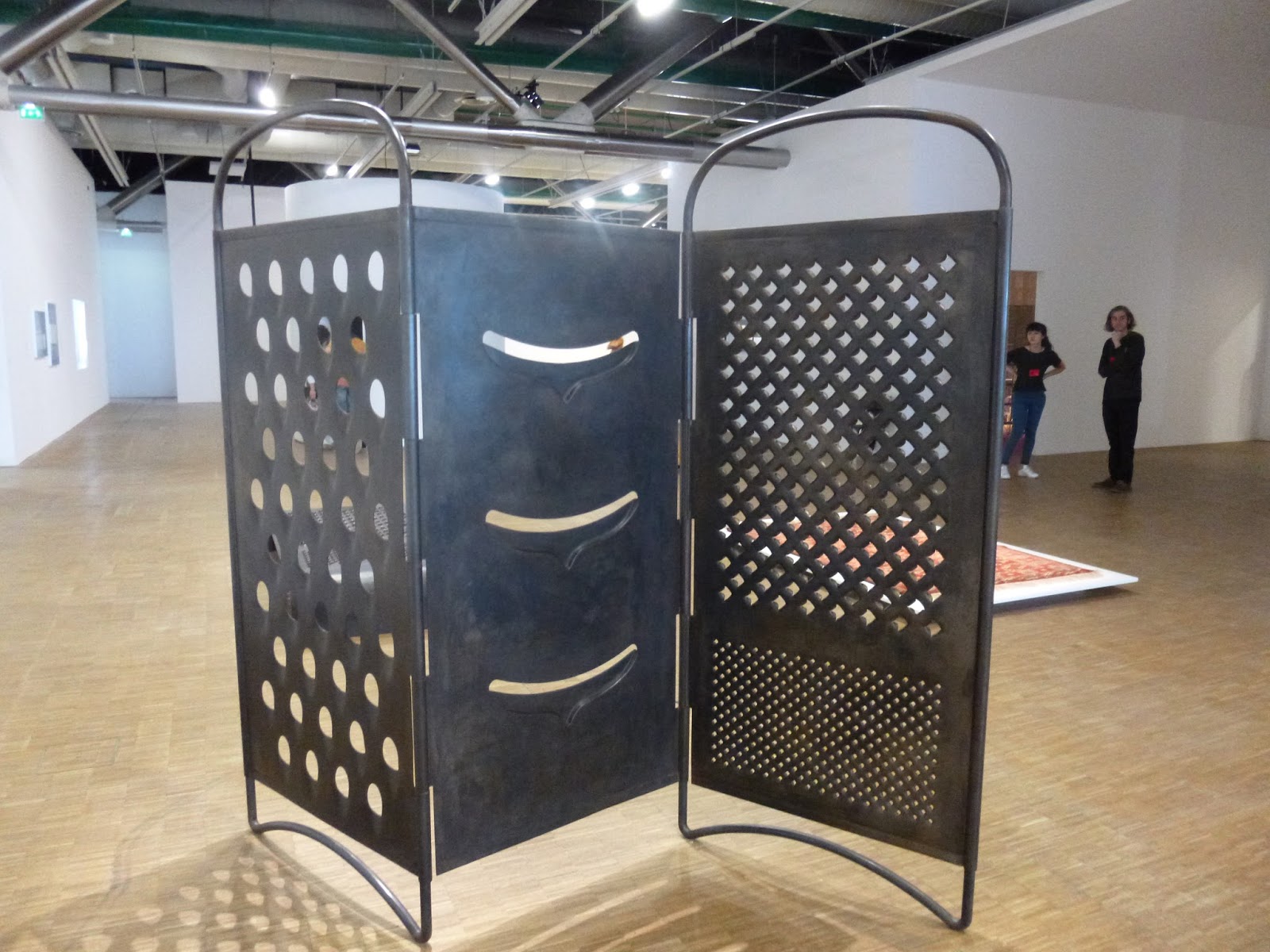
Here are videos (not often enough with seating, so mind your back if you want to watch them all, or make like the 60s and sit on the floor), installations, photographs, drawings and for some reason, some enormous cheese graters. You may groan a little at her terrible punning titles (Grater Divide, and Light Sentence), but there should be something for everyone, except the squeamish. Those not fond of offal should look away now.

Her life story and the exploration of her Lebanese identity and the violent dislocations of her homeland are the major subjects of her work. She uses all kinds of materials including human hair, woven, balled and embroidered with - watch our for the gentle tickle as you walk through one of the rooms.

Her fascination with mapping is displayed in projections on paper, glass beads, bars of olive oil soap and thread bare carpets. We didn't learn to do anything so ingenious when I studied cartography at University, more's the pity.

Not that I could exactly sneak it out under my coat, but the red globe I would happily take home and I admired the craft and tapestry skills of the women who made Twelve Windows.

It's on all summer, so pick a less than scorching day if you don't want to get heat stroke making your way to the top of the building (the exhibition space is air conditioned) and hithee.  Enjoy. I will be doing so many times in the coming weeks.

Friday, 15 May 2015

Savage Beauty - Alexander McQueen at the V&A

I have run out of superlatives. For once I was speechless. This show is an absolute must-see, even if like me you are not exactly a fashionista, but admire well made things.

McQueen transcended the cat walk to make clothes that are all theatre and more and beyond. There were just too many marvels for me to talk about. It literally took my breath away and I didn't know where to look next.

I wanted to swish off in so many of these dresses it was very, very hard to leave in the clothes I came in. And with my teenage Goth daughter and huge McQueen fan in tow, I had an absolute ball. Do not hesitate for one moment.

Tracey's Bed and other things at Tate Britain

So there it is again, the sheets are still filthy dirty, the litter, used condoms, tampons and other detritus are still, well, there. Her slippers are still naff and the pair of tights is still slung on top of the duvet. But honestly, what was the fuss all about? It's strange looking at something that caused such a furore at the time. I liked it's iconoclasm when it was first put on show in 1999. I like it still. If you've never seen Tracey Emin's My Bed it in all it's glory, off you go to the permanent collection. Enjoy people's reactions.

But while you are there, think seriously and twice about going to the other current exhibitions. I was pretty underwhelmed by Sculpture Victorious because it is so much of a mishmash: partly about the Great Exhibition, party about sculpture in 1800s, but a bit all over the shop for me. It never does for me to enter an exhibition into a first room of sculpture of a monarch, Queen Victoria in this case. I'm Welsh. We don't do the royal family.

However I was astounded to learn that something like 6,000 elephants were slaughtered for their ivory every year to meet British demand alone in the mid-nineteenth century. The only good things to my jaded eye were a Byrne-Jones I have never before spied of Perseus and the Graeae (part-painting part-metal work, not exactly a sculpture), the Eric Gills and my favourite python-wrestling hero by Leighton.

Salt and Silver sounded promising, being as it is about early photography (salt paper prints) and the works are to be admired for technical achievement, but the subject matter is rather predictable and frankly dull, with one exception. The photographs from the Crimean War are worth a good look. I was especially taken with one of a cantiniere, who despite being in a campaign had time to lace her corset and pull in her perilously tiny waist.

The third exhibition, and yes, I did spent the best part of a day there, is also of photography  - Nick Waplinton's collaboration with Alexander McQueen, no doubt timed to coincide with the block busting show at the V&A. I am a big fan of huge glossy prints and the space to enjoy them, but I was more than a little bemused by the fashion shot, plate, costume  juxtposed (sic) by pictures of rubbish, literally and in close up, by which I mean plastic, broken glass, black bin liners and the like, all in sordid detail. It seemed a bit graduate show to me, but hey, make up your own mind.

Monday, 4 May 2015

Marlene Dumas at Tate Modern

Just a week left to rush to the South bank to see this one. Dark, disturbing, a challenge to your sense of what makes a portrait, this huge retrospective, the first in Europe, is not to be missed.

For the portraits of the famous, it is worth the price of admission alone. Go, go, go. Stop reading this and go.

Dumas crafts from photographs not life and transforms her subjects into something quite other.

Favourite things are the children - more scary than innocent, the Magdelena series, which includes the haunting portrait of Naomi Campbell, and her twists on conflict in the Middle East.

The one I wanted to slip into my bag and take home was Girl with a Skull - I could weave stories from it for days. If you want to see Amy Winehouse in blue, this is where you'll find her. Full of images and not a burden at all. Breathtaking. Hurry.

Tuesday, 28 April 2015

Indigenous Australia at the British Museum


One of my abiding childhood memories from the three years we lived in Australia is buying a long tailed lizard from the aborigine boy who whittled and polished it. I have packed and taken it right around the world several times and it sits in my cabinet of curiosities still. I don’t recall on which trip out into the bush this was, or even where, beyond the safety of suburban Adelaide, we were, but I do remember the boy’s rough hands and his toothy smile and thinking how very different his life was to mine.


No surprise then that this newly opened exhibition at the British Museum was a must see for me. It is packed with interest, but not quite as extensive as I would have hoped. I would have liked many more paintings rather than the few representative examples. That said, what is there is, is magnificent, even if I do need the legend for their deciphering. Perhaps it is not so curious that I lack the cultural knowledge to tell digging stick women from the Rainbow Serpent or the tracks of a King Brown.

Beyond the paintings, there is much to learn from the artefacts on display. Things I did not know included the number of different types of boomerang there are, the purpose of a biting bag and the existence of a honey gathering hook. There are cross shaped boomerangs for hunting flying foxes. The biting bag or spirit bag is for male use in mortuary rights and initiation, bitten to access spiritual powers. It contains feathers, plant fibres and other objects. The honey gathering hook is used to collect flowers from grevillea trees. Fascinating and each object very beautifully made for its given purpose.

The exhibition tells the story of the oldest continual communities on earth and of their relationship to country, but is misses crucial things. There is mention of aboriginal populations being decimated, but their being hunted to near extinction for sport by the British in Tasmania is side-stepped. The lost generations of forcibly removed children put up for adoption by white families, a policy which shockingly was still going on into the 1970s, are mentioned, but only briefly, as is the current matter of land rights. I would have expected a great deal more of these narratives to take us beyond objects, or rather, to give them fuller context.

Casting around for the most beautiful things, I was taken by the collection of exquisitely fashioned spearheads made in the 1930s from coloured glass bottles, telegraph pole insulators and stone. So much careful work for one throw of the spear at kangaroo bone. Check it out yourself, but be warned, the rooms are very hot, like the red earth country from which these treasures come.

Sunday, 19 April 2015

From Giotto to Caravaggio - Musee Jacquemart-Andre


Meanwhile back in Paris, this recently opened exhibition of Italian mediaeval and Renaissance paintings. And who doesn't love a good Caravaggio, or two or three?

As I have not visited this museum before, I was delighted to see this. But wouldn't you know it, I was entranced by something other: an exquisite Madonna and child by Masaccio.

Mary's face is so gentle and beautiful, it almost made me weep and the lapis of her robe so bright, it looked unbelievable. The infant Christ on the other hand, like all babies in art of these periods, is singuarly dreadful.

Other paintings I for your attention are the large triptych of saints by de Ribera. Each one a stunning portrait of a real individual.

Whilst the subject matter of most of the works is not really in the top ten to my taste or interest, as many have travelled to Paris from Florence, save yourself a trip to Italy and take a look.

The permanent collection is worth your time also with Botticelli, Canaletto and the like to enjoy along with the sumptuous furnishings of the hotel. There is also a lovely cafe for a refreshment break and staircases to swoop down regally.


Friday, 17 April 2015

Diebenkorn at the Royal Academy

Richard Diebenkorn illuminates the RA with Californian sunshine, or was it just because I was there last week on the first sunny day we have had all year?

It is a joyful and uplifting survey of his work and reminded me of all the things I miss about the Bay area, notably the colours and light. 

If you like your landscape abstracted, contemplate away, but Diebenkorn was also a gifted portraitist.

It’s a relatively small show, but there is much to enjoy if you take your time and meditate on it awhile - a serene break from the bustle of Piccadilly

Saturday, 7 March 2015

Architectural Sauvage/Salvage


During the French Revolution the statues of the kings of France were toppled from the facade of Notre Dame by a mob intent on destroying not religious idols, but the idolatry of Feudalism. They were decapitated, blinded, gouged and left in a heap to be used a a public toilet. They were cleared away at some point and used to shore up the foundations of a building. They were discovered by chance in 1977, the year that was the zenith of punk with its, here, ironic cry of "Destroy."

Knight killing a King, Mediaeval stained glass, Musee de Cluny
Today they are displayed in the day-lit salle de Notre Dame in the Musee de Cluny, but not in silence as the air conditioning keeps up enough noise to drown out passing police sirens from the street outside. A few people wander in and out, not staying long enough to do more than give a sideways glance to the worn crowns (in both senses), broken noses and crumbling stone. The noise seems right. Calm would be too much reverence for these relics of violence.

Art is destroyed in all revolutions, it seems to be part of the process, clearing away the old, making room for the new.  There are many examples - in my own lifetime, say those statues of Lenin littering architectural salvage yards in Britain in the 1990s, the Banyam buddahs blown skywards, the libraries in Timbuktu, and this week the destruction of Nimrud by bulldozer. We may not like it. We may call it a war crime. We may not even think it qualifies as art in some cases; cultural heritage comes in many guises.

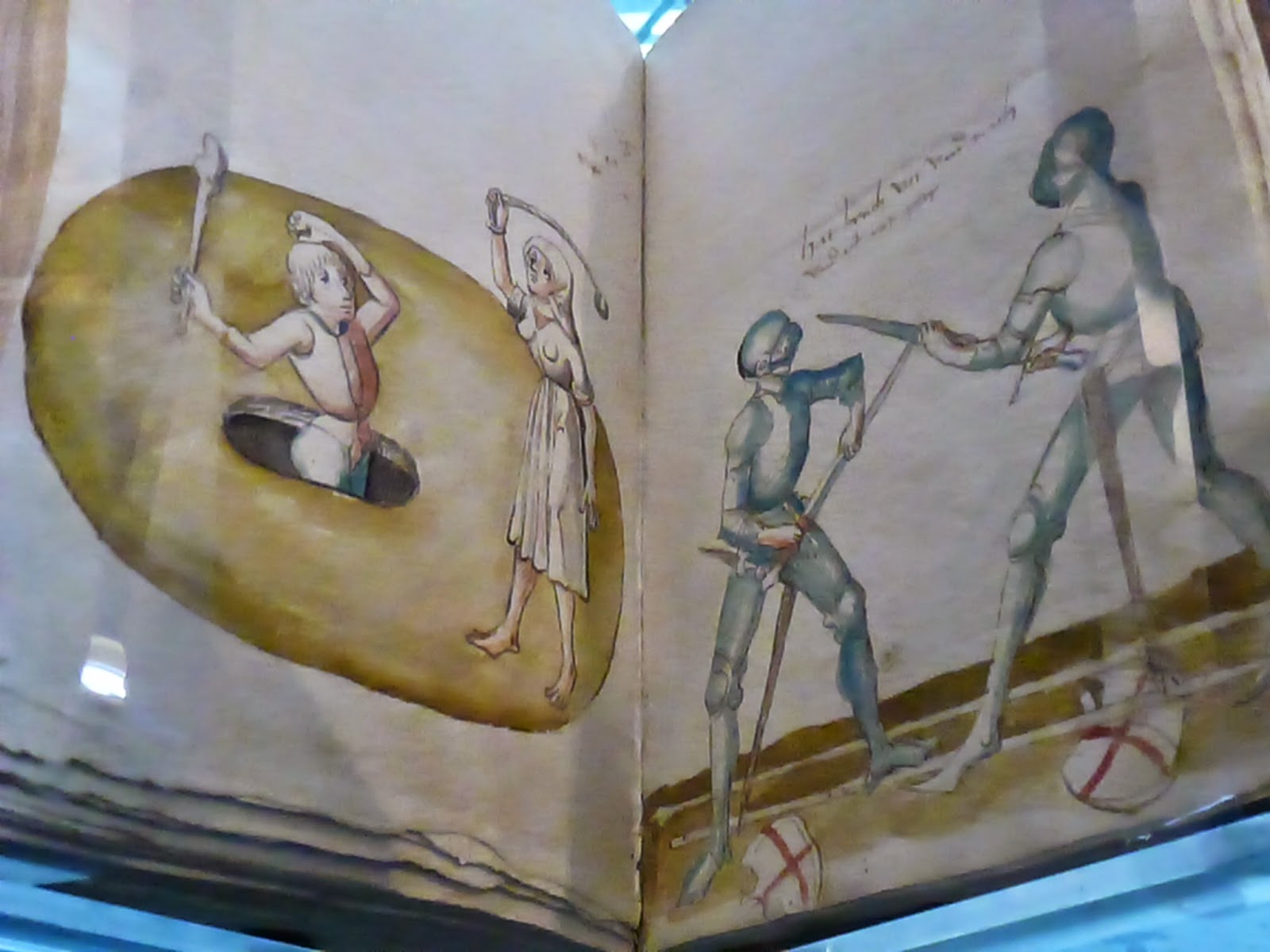
Mediaeval book on the art of warfare, Musee de Cluny
The pity of it is that no human shield saved that part of the Assyrian Empire, unlike the Cairo Museum. People are rightly too terrified of the men with guns. And we? We watch from afar, safe in our places. We sit and we watch our screens and tut and say it's terrible and do nothing, except write, as I am free to do now. The irony of this post is not lost on me.

Idolatry, Mediaeval stained glass, Musee de Cluny
But what of the hypocrisy of selling artefacts to fund oppression, whilst obliterating others for fear of idol worship. How exactly do you chose, I wonder? I imagine portability is the key. Large statues don't exactly fit in the post. And what's the point of having all those automatic weapons and jack hammers if you are not going to use them, pray? But who is buying the looted treasure, and why don't we hear so much more about and do something about the daily destruction of human lives? Could it be because any kind of action really is in the too-difficult-no-quick-buck-in-it box? If it is, then I despair, again.

I was taken recently by comments in a interview with Mark Rylance in which he pointed out that Islam was about 500 years younger than Christianity and 500 years ago we were busy chopping off heads, burning people and smashing idols. It was called the Reformation (and Counter-Reformation). So is what is happening today very much of a surprise? No, not really, but at least the Assyrian culture lives on in other museums. Reason then for not giving back acquired things? Perhaps.


Sunday, 21 December 2014

Inside at the Palais de Tokyo

The Palais de Toyko is huge and I mean enormous. It must be the biggest space for contemporary art in the city, so Thursday night and with my daughter in tow I finally made it there to Inside, which is a group show of wonderful work.

As you can expect, it's a little mixed too. Some of it will leave you with eye ache, such as the room of white sculptures, some will entrance, like the many wonderful videos, and some of it will leave you surprised and some unmoved.


But if you want to crawl inside an installation made entirely of Scotch tape, walk thorough a destroyed house, watch it raining inside and see a lot of beautiful drawing including street art down the staircase, then here are many, many things to enjoy.

It's not cheap at 12 Euros, but it kept us talking. laughing and asking questions for three hours, which is probably the point. Enjoy!