Tuesday, 1 September 2015

The Grayson Perry House, Wrabness

Wrabness is a small nowhere kind of a place on the incredibly beautiful Stour estuary in Essex, blighted only by views of Feilxstowe, but docks and container ports have to go somewhere now,  don't they? There is a railway station, a pub or two, a community shop and the Grayson Perry House.

Nothing to see inside unless you book it at vast expense from the Landmark Trust, but it's free to walk around the garden fence and take a few photographs of this amazing confection for Perry's fictional all-Essex woman, Julie. Go on a sunny day when the roof is positively golden and it is something of a marvel.

Monday, 17 August 2015

Richard Long at the Arnolfini


I state my bias right away: Long is my hometown artist who I most admire.  His word work is poetry pared down to its most simple essence: the significant things we notice along the way.

And moving throughout the landscape is what this work is all about. The walk. Everything else is just recording and documenting. Which makes it rather difficult to mount an exhibition.

Happily the words on the walls work their magic, as do the site specific mud paintings and the slate cross.

New mud thumb prints are charming in their aboriginal patterning.

Meanwhile out of the gallery up on the Downs is Boyhood Line, which is worth finding (one third of the way up Ladies Mile on the right as you leave Clifton, if you want directions, as I had to ask three gallery staff before finding one who could show me, but not furnish me with, a map). The grass is overtaking the white stones and there is a certain amount of public interference going on, as Long expected.

My only quibble, and it's not a small one, is that the Arnolfini does not have anywhere near enough gallery space to do Long's work justice. Not by a long chalk. There simply wasn't enough of on show to make a trip from anywhere other than Bristol worthwhile. Luckily, I was passing, otherwise I would have been sorely disappointed. But if you are local and like your art conceptual and constrained, enjoy this this summer.

Monday, 3 August 2015

France Profond


The usual wind takes the heat out of a sunny day on the first weekend in August. Northern France. The wheat harvest is in full swing - combines and grain carriers churn across the land with all the efficiency mechanized agriculture can afford. In the sea of golden grain, patient maize and two-tone cattle lie different plots. At regular intervals British and other cars stop beside the fields of white and green that dot the Somme landscape every quarter of a mile or so.

The curious, the buffs, the just-passing, the serious historians, the searches of family history, whatever their motives the passengers spare the time to stand in the corners of these forever England places. Of course, they are more than forever England as the Welsh, Irish, Scots, Australians, New Zealanders, Canadians, Indians, French, and Germans will attest.

We came to the Le Tournet Monument in search of one particular grave. And that’s a thing in itself. Not all the men slaughtered in this place a hundred years ago were afforded such. The names on the monument, just 13,400 of them here, are all that there is to mark these men. 

My relative on the other hand has a headstone, a beautiful piece of creamy marble, kept moss and lichen free by the commendable Commonwealth War Graves Commission.  On it, under the Prince of Wales feathers of the Welsh Regiment and above the simple cross are his name, J. Lewis, his rank – Private, his army number and the date he died, 13 February 1916.

What is missing is that he was John Lewis, my great, great uncle, and that he was only twenty when he was the target of a German sniper early on a Sunday morning in the bitterest month of winter. I remember my great grandmother telling me about her lovely brother when I was a small girl. We have photographs of him. We have a geology book he inscribed.


Here we are then, nearly one hundred years later, taking a pause in our busy lives, feeling rather goose bumpy, writing a message in the visitors book, taking pictures, and making a mental note of where he is. If you stand one meter to the left of the right hand pillar at the entrance to the monument and look towards the oak tree, his grave is directly in front of you in the fourth row in front of the tree, beside four other Welsh boys, all about the same age, all killed days apart. 

Sunday, 28 June 2015

Musee Albert Kahn

When the heat bouncing off the stone is too too much, it's time to seek out the shade. In all sorts of hidden places in Paris there is plenty of greenery, as in here at the end of line 10 at Boulogne Billancourt.

As I am currently plotting a small Japanese creation, this was the spot for a little gardening homework, rest and reflection. Not only is it a lovely stroll garden, but there is also a French fruit and roses garden and a more classically English garden with some fine specimen cedars and conifer wood.

Water is everywhere as pond, rill, stream, waterfall and cascade, all controlled to fall in pleasing harmony. Enormous koi cruise the main pond. A fringe of tadpoles edged a runnel.

It's the perfect place to forget the city, if you can close your ears to the traffic noise for a while, sit back and dream. Super Sunday.

Friday, 26 June 2015

Mona Hathoum at the Pompidiou

Ha! So Paris gets an astonishing show before London. Happiness all round and bad luck the Tate, you have to wait until 2016.

Mona Hatoum's work, in one hundred pieces here is wonderful. But then I am a sucker for anyone who does things with maps. I recall first coming across her many years ago - the film of her colon, I think as a Turner prize contender - it is challenging and well executed, and here it is again in it's own little round space in the first gallery.

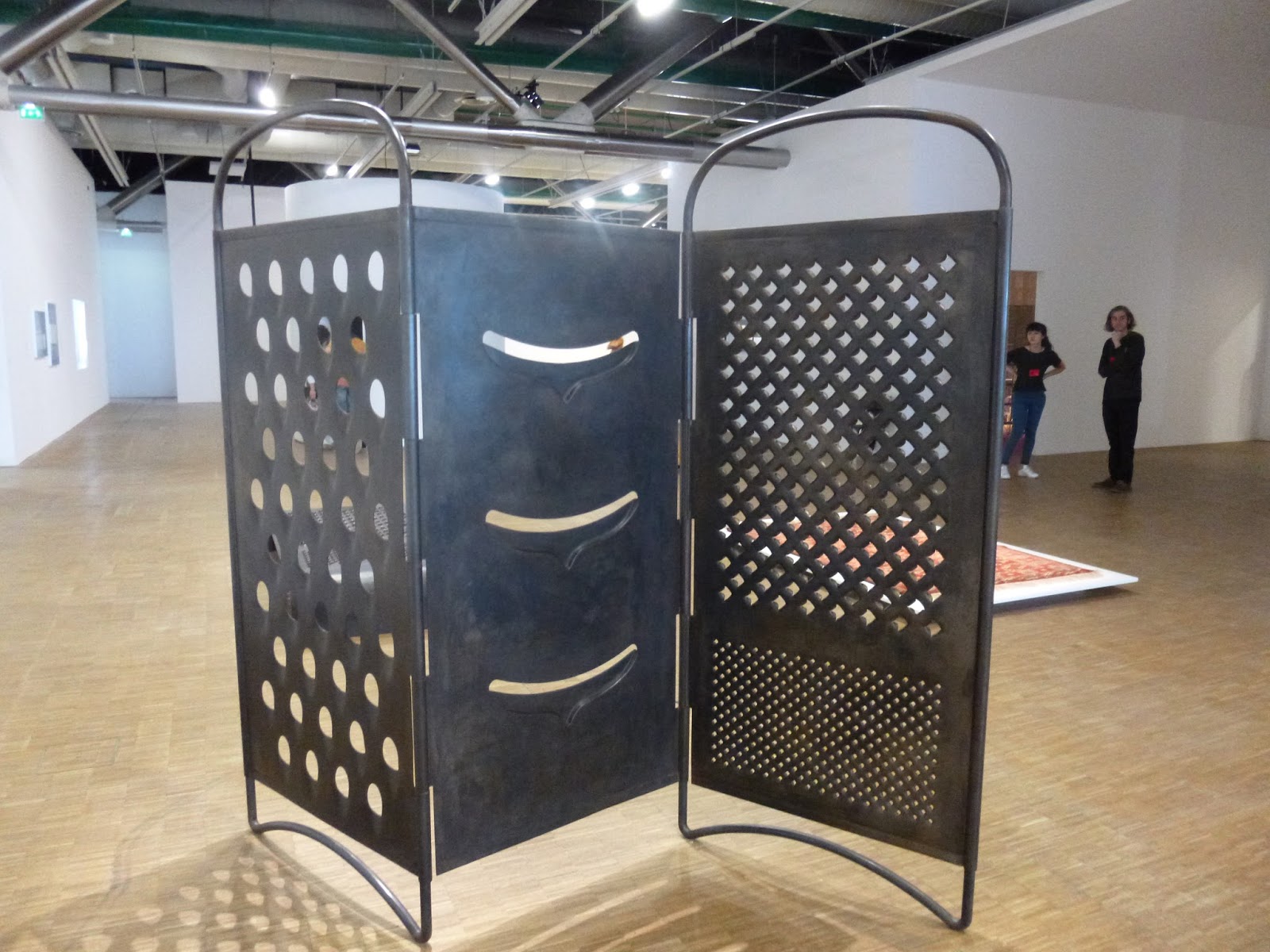
Here are videos (not often enough with seating, so mind your back if you want to watch them all, or make like the 60s and sit on the floor), installations, photographs, drawings and for some reason, some enormous cheese graters. You may groan a little at her terrible punning titles (Grater Divide, and Light Sentence), but there should be something for everyone, except the squeamish. Those not fond of offal should look away now.

Her life story and the exploration of her Lebanese identity and the violent dislocations of her homeland are the major subjects of her work. She uses all kinds of materials including human hair, woven, balled and embroidered with - watch our for the gentle tickle as you walk through one of the rooms.

Her fascination with mapping is displayed in projections on paper, glass beads, bars of olive oil soap and thread bare carpets. We didn't learn to do anything so ingenious when I studied cartography at University, more's the pity.

Not that I could exactly sneak it out under my coat, but the red globe I would happily take home and I admired the craft and tapestry skills of the women who made Twelve Windows.

It's on all summer, so pick a less than scorching day if you don't want to get heat stroke making your way to the top of the building (the exhibition space is air conditioned) and hithee.  Enjoy. I will be doing so many times in the coming weeks.

Sunday, 14 June 2015

Marche de la Poesie

Every June all the editors of poetry in France gather in the place outside Saint Sulpice (nice Delacroixs inside fyi) in the 6eme for the grand showcase of their wares.

Beautifully designed books and books as objets d'art abound. Whilst the poetry is still a little beyond my grasp language wise as I wrestle with meaning rather than being able to appreciate its elegance, I spent a sunny afternoon enjoying the general hubbub.


The poetmaton was fun. Enter booth, listen to two poems read by a real person, in this case a lovely lady who takes a good look at you and then decides what to read to you, enjoy, exit collecting your poems before leaving. Very cool.

Sunday, 31 May 2015

The Sunken Chip

Be warned, I am not given to writing restaurant reviews, but about twice a year I have the over-whelming desire to each fish and chips. Before being overtaken by Chicken Tikka Massala, it was our national dish. Funnily enough, it is not the national dish of France.

Until now I've had to put up with Belgian chips, all very good and you can even buy them by the kilo at the chip shop near the Pantheon, but no battered fish, not anywhere. French fires are not the same, not in the slightest. 

Hello, The Sunken Chip. To my knowledge, it is the only place in Paris where you can get real fish and chips in a real (bar the fat filled air) fish and chip shop. Although in this one you can sit down and it doesn't have the stainless steel counter and they don't cook before your eyes, but still.

Friday night and that longing comes over me, so off we go. There is a choice of fish, but sadly no plaice, they never have that, and surprisingly no cod (whaaat? that's the basic one)  The haddock was excellent though, the chips perfect - not a soggy tattie in sight, and the mushy peas were minted and fresh. Home made mayonnaise? Yum. 

On the downside, the ketchup was not Heinz - criminal, and they had run out of Magners and Newcie brown - unforgivable.

But if you want battered sausage and picked eggs washed down with R Whites or Iron Bru, hithee to the Canal Saint Martin. Licks lips, wipes grease from chin.