Tuesday, 28 April 2015

Indigenous Australia at the British Museum


One of my abiding childhood memories from the three years we lived in Australia is buying a long tailed lizard from the aborigine boy who whittled and polished it. I have packed and taken it right around the world several times and it sits in my cabinet of curiosities still. I don’t recall on which trip out into the bush this was, or even where, beyond the safety of suburban Adelaide, we were, but I do remember the boy’s rough hands and his toothy smile and thinking how very different his life was to mine.


No surprise then that this newly opened exhibition at the British Museum was a must see for me. It is packed with interest, but not quite as extensive as I would have hoped. I would have liked many more paintings rather than the few representative examples. That said, what is there is, is magnificent, even if I do need the legend for their deciphering. Perhaps it is not so curious that I lack the cultural knowledge to tell digging stick women from the Rainbow Serpent or the tracks of a King Brown.

Beyond the paintings, there is much to learn from the artefacts on display. Things I did not know included the number of different types of boomerang there are, the purpose of a biting bag and the existence of a honey gathering hook. There are cross shaped boomerangs for hunting flying foxes. The biting bag or spirit bag is for male use in mortuary rights and initiation, bitten to access spiritual powers. It contains feathers, plant fibres and other objects. The honey gathering hook is used to collect flowers from grevillea trees. Fascinating and each object very beautifully made for its given purpose.

The exhibition tells the story of the oldest continual communities on earth and of their relationship to country, but is misses crucial things. There is mention of aboriginal populations being decimated, but their being hunted to near extinction for sport by the British in Tasmania is side-stepped. The lost generations of forcibly removed children put up for adoption by white families, a policy which shockingly was still going on into the 1970s, are mentioned, but only briefly, as is the current matter of land rights. I would have expected a great deal more of these narratives to take us beyond objects, or rather, to give them fuller context.

Casting around for the most beautiful things, I was taken by the collection of exquisitely fashioned spearheads made in the 1930s from coloured glass bottles, telegraph pole insulators and stone. So much careful work for one throw of the spear at kangaroo bone. Check it out yourself, but be warned, the rooms are very hot, like the red earth country from which these treasures come.

Sunday, 19 April 2015

From Giotto to Caravaggio - Musee Jacquemart-Andre


Meanwhile back in Paris, this recently opened exhibition of Italian mediaeval and Renaissance paintings. And who doesn't love a good Caravaggio, or two or three?

As I have not visited this museum before, I was delighted to see this. But wouldn't you know it, I was entranced by something other: an exquisite Madonna and child by Masaccio.

Mary's face is so gentle and beautiful, it almost made me weep and the lapis of her robe so bright, it looked unbelievable. The infant Christ on the other hand, like all babies in art of these periods, is singuarly dreadful.

Other paintings I for your attention are the large triptych of saints by de Ribera. Each one a stunning portrait of a real individual.

Whilst the subject matter of most of the works is not really in the top ten to my taste or interest, as many have travelled to Paris from Florence, save yourself a trip to Italy and take a look.

The permanent collection is worth your time also with Botticelli, Canaletto and the like to enjoy along with the sumptuous furnishings of the hotel. There is also a lovely cafe for a refreshment break and staircases to swoop down regally.


Friday, 17 April 2015

Diebenkorn at the Royal Academy

Richard Diebenkorn illuminates the RA with Californian sunshine, or was it just because I was there last week on the first sunny day we have had all year?

It is a joyful and uplifting survey of his work and reminded me of all the things I miss about the Bay area, notably the colours and light. 

If you like your landscape abstracted, contemplate away, but Diebenkorn was also a gifted portraitist.

It’s a relatively small show, but there is much to enjoy if you take your time and meditate on it awhile - a serene break from the bustle of Piccadilly

Tuesday, 7 April 2015

Punk and my writing

The first word that sprang to mind as I was thinking about this piece was nostalgia: not the soft focus hankering for things or days past, but a reminder of where I came from, of formative influence. I can no more forget the importance of punk in my personal and artistic development than I can my ethnic cultural heritage. 

My poetry is rooted in the rhythms and language of Anglo-Welsh, not in a conscious or contrived manner, it's just how I write and what seems most natural to me. These are the patterns of language I learnt as a child. I cannot, and have no desire to, unlearn them.

So I am saddened by people who want to expunge their punk past. Why? It was the most exciting thing to happen to British culture in the Twentieth Century and I say that not just because I was peripherally there. Why would you want to forget it?

Punk informs my writing. I need and ask no permission to write whatever I want: whatever topic, in whatever style, using whatever language I choose. I can swear and be 'offensive' and 'outrageous' if I like, whatever these terms mean, without self-chastisement. I am not using naughty words or excusing my language, subject matter or approach to myself or anyone else. I can break all the rules of poetry if I want and still make work that is pleasing. To do this I have exorcised my internal critic. J'etais toujours Charlie.

And I don't really care what the reader thinks. I am not writing for any particular audience. Poetry by poll or committee can never produce anything of merit. No, I write to please myself and I am gratified that my work touches other people or that I hear the sigh of recognition or a peal of laughter from the crowd at a reading. Even if I was in an audience of one: me, alone, that's all that matters. I am doing it by and for myself. And that's a punk thing.

Saturday, 7 March 2015

Architectural Sauvage/Salvage


During the French Revolution the statues of the kings of France were toppled from the facade of Notre Dame by a mob intent on destroying not religious idols, but the idolatry of Feudalism. They were decapitated, blinded, gouged and left in a heap to be used a a public toilet. They were cleared away at some point and used to shore up the foundations of a building. They were discovered by chance in 1977, the year that was the zenith of punk with its, here, ironic cry of "Destroy."

Knight killing a King, Mediaeval stained glass, Musee de Cluny
Today they are displayed in the day-lit salle de Notre Dame in the Musee de Cluny, but not in silence as the air conditioning keeps up enough noise to drown out passing police sirens from the street outside. A few people wander in and out, not staying long enough to do more than give a sideways glance to the worn crowns (in both senses), broken noses and crumbling stone. The noise seems right. Calm would be too much reverence for these relics of violence.

Art is destroyed in all revolutions, it seems to be part of the process, clearing away the old, making room for the new.  There are many examples - in my own lifetime, say those statues of Lenin littering architectural salvage yards in Britain in the 1990s, the Banyam buddahs blown skywards, the libraries in Timbuktu, and this week the destruction of Nimrud by bulldozer. We may not like it. We may call it a war crime. We may not even think it qualifies as art in some cases; cultural heritage comes in many guises.

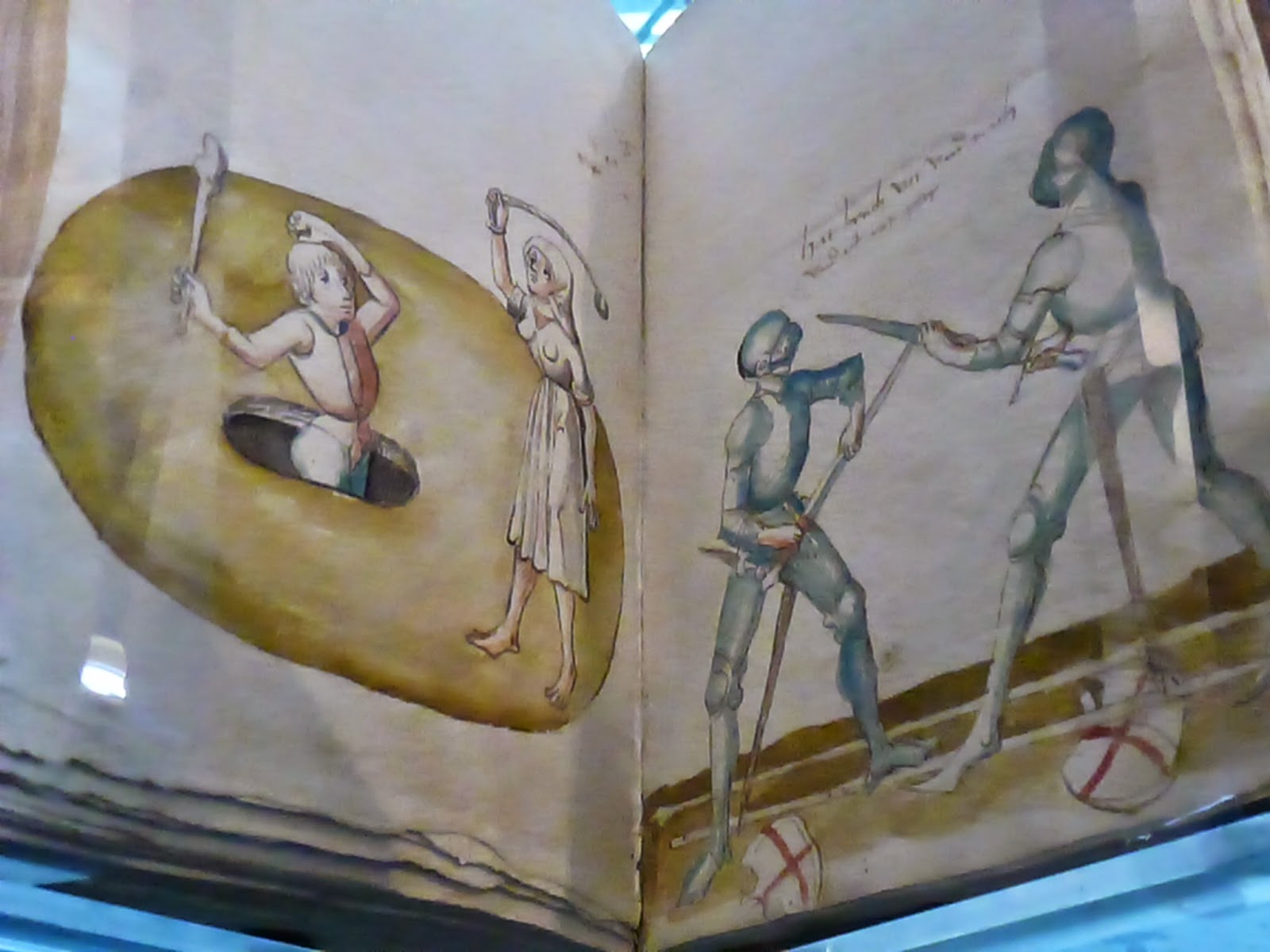
Mediaeval book on the art of warfare, Musee de Cluny
The pity of it is that no human shield saved that part of the Assyrian Empire, unlike the Cairo Museum. People are rightly too terrified of the men with guns. And we? We watch from afar, safe in our places. We sit and we watch our screens and tut and say it's terrible and do nothing, except write, as I am free to do now. The irony of this post is not lost on me.

Idolatry, Mediaeval stained glass, Musee de Cluny
But what of the hypocrisy of selling artefacts to fund oppression, whilst obliterating others for fear of idol worship. How exactly do you chose, I wonder? I imagine portability is the key. Large statues don't exactly fit in the post. And what's the point of having all those automatic weapons and jack hammers if you are not going to use them, pray? But who is buying the looted treasure, and why don't we hear so much more about and do something about the daily destruction of human lives? Could it be because any kind of action really is in the too-difficult-no-quick-buck-in-it box? If it is, then I despair, again.

I was taken recently by comments in a interview with Mark Rylance in which he pointed out that Islam was about 500 years younger than Christianity and 500 years ago we were busy chopping off heads, burning people and smashing idols. It was called the Reformation (and Counter-Reformation). So is what is happening today very much of a surprise? No, not really, but at least the Assyrian culture lives on in other museums. Reason then for not giving back acquired things? Perhaps.


Saturday, 7 February 2015

Will Self at Maison de la Poesie


Just every now and then Maison de la Poesie plays host to one of the greats and let me be clear here, I love Will Self, not in that teenage fancy-him-do-you way, no (she lied), but I think he is a clever and innovative writer. I enjoy his novels hugely and eagerly devour his journalism. As a cultural commentator he has something pithy to say on a number of topics that interest me, and he likes walking the urban space and psychogeography. How many more boxes can the man tick? Oh, yes and he has his wild side. Shame he's already spoken for.

Last night he was in Paris to launch his recent novel Umbrella, Parapluie to you, which was published this week in French. He gave a brilliant reading along with the French translation that was suitably animated. It was interesting to note the translation now that my French is so much better. I noticed a few words that I would have put quite differently for the colour and vivacity of Will's English to shine, but that it to pick nits.

The novel, in which he nods to weighty Modernist predecessors (Joyce, Woolf et al), is concerned with disease (a real pathology - remember Oliver Sacks and the film Awakening), technology innovated by war and the individual. Its cover quote from Joyce that 'a brother is as easily forgotten as an umbrella' is for Self the summation of the theme.  On the style, which has been criticised as hard, Will explained the use of the continuous present, the lack of breaks between the consciousness of one character and another and how he was pleased to have finally killed god, in the form the omniscient narrator.

To an embarrassing question as to why he was in Paris as the novel was published years ago, I expected a vicious answer along the lines of not in French it wasn't, matey and it's my job to promote my book, you [expletive deleted], but Will was in gentle mood, kindly explaining the author's role in nurturing his book baby.

Questions I would have asked if I hadn't been so tired at the end of the week: Just how pissed off were you not to win the Booker Prize, and If narrative is no longer in the novel and has moved elsewhere, where is it in text art?

I'd like to suggest that narrative exists in poetry (I like to think I can write a whole novel in a narrative sense in one poem) and that we might see a resurgence of poetry in our sound bite age where text is reduced to tweets and flashes and our attention span is ever shorter for reading, especially novels.

Will characterised this situation by berating well educated people who can no longer be arsed (my word) to read or interact with high culture because a novel can't be clicked on to explain it meaning and who think this is an acceptable position. He was scathing about those who'd rather read children's books.

Sound bites to chew over:

Progress is the upgrading of the world every five years.

All is steampunk - obsolete technology is all around us such as an umbrella.

The serious novel is a philosophical form. It has to say something about existence.

Wednesday, 7 January 2015

Close brushes

A very sad day in Paris today indeed. One on which by all rights I should become enraged and take to the streets. My present incapacity prevents me from doing this, so I shall use my mighty pen instead.

I have been reflecting this afternoon on my close brushes with terrorism:

Debenhams's bomb, IRA, Bristol, 18 December 1974 - I was tucked up in bed that night a mere three miles away.

Harrod's bomb, IRA, London 17 December 1983 - I was down the road in South Kensington eating lunch with friends when we heard the blast.

Planet Hollywood bomb, Islamic fundamentalists, Cape Town, 26 August 1998 - I left the restaurant just three hours before it detonated. The bomb was strapped to the bar the whole time we were there.

Bakerloo line bomb, Islamic fundamentalists, London, 25 July 2005 - I passed through Baker Street Station on my way to work on an earlier train, just fifteen minutes before the suicide bomber flicked the switch to his backpack.

Charlie Hebdo office shootings, Islamic fundamentalists, Paris, 7 January 2015 - in the next arrondissement to mine, a short walk away.

These are of course as nothing to the experiences of some people I know who have lived through wars or witnessed killings right in front of them, but they are my own small reminders that we cannot live untouched by world events. Danger is closer than you think.

No matter how much we might want to draw up the shutters and focus on other things, we can't. So for those of you heading to Place de la Republique this evening, light a candle for the dead and light a candle for the future, for all of us to continue to write, say and shout exactly what darn well please. Exercise the freedom that we hold so precious. Flex those muscles. Let me hear you roar.